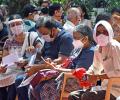
'The problem is delaying (or missing) the second dose would probably keep you at a 20 per cent risk of still getting COVID-19, till you are fully immunised.'
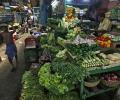
Inflation has reappeared as a global issue in both advanced and emerging economies and India needs to be wary of "imported inflation", especially due to high oil prices, according to the Economic Survey 2021-22 released on Monday. "Inflation has reappeared as a global issue in both advanced and emerging economies. "India's Consumer Price Index inflation stood at 5.6 per cent YoY in December 2021 which is within the targeted tolerance band," the survey report presented in the Parliament by Finance Minister Nirmala Sitharaman noted.

Authorities at several private hospitals in the national capital on Monday scampered to refill their oxygen stocks as the lives of many COVID patients hung by a thin thread amid an acute shortage of the life-saving gas.

India is struggling with the second wave of coronavirus infection and hospitals in several states are reeling under a shortage of medical oxygen and beds in view of a rising number of COVID-19 cases.

This is apart from the requirement to stock hydroxychloroquine (200 mg) and Azithromycin (500 mg) tablets for patients requiring ICU management, asymptomatic healthcare workers and asymptomatic household contacts of positive cases.

The government is engaged in talks with telecom firms for a launch of commercial 5G services in some cities by Independence Day and has assured them that spectrum auction will take place in April-May, providing them a three to four-month window for the rollout. A top executive of a leading telecom gear company said the deadline was feasible in some cases. "It can be achieved in some cities as it will take us 4-6 weeks to deploy a network, once the equipment or components have reached India.

This is a national leadership gone so wrong that India's most powerful prime minister in four decades has personally taken charge of medical oxygen shortages, observes Shekhar Gupta.

For Q4CY20, PC shipments grew by 27 per cent year-on-year, said data from the IDC.
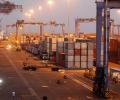
Developed countries are relaxing restrictions on economic activity at a faster rate than expected. Global demand for consumer goods, intermediates and commodities is growing at a fast pace. Most exporters are flushed with orders, says T N C Rajagopalan.
The economy is likely to register a 9.5 per cent growth this fiscal over 7.3 per cent contraction last year, as the ongoing recovery is faster and more credible than earlier foreseen, according to a foreign brokerage report. It will gather more momentum in the second half of the current fiscal, but will slow down to 7.7 per cent next financial year, it added. The government has budgeted for a 10.5 per cent growth this fiscal, but the Reserve Bank has scaled it down to 9.5 per cent.

Every week, we bring you fascinating videos, chosen by you, through your likes.

Seventeen children died in the neo-natal ward, five in the acute encephalitis syndrome ward and eight in the general ward.

Labuschagne has admitted that being overlooked at the IPL auction turned out to be 'blessing in disguise'

Top officers across various ministries participate in the meeting that started at 8 pm on Saturday. The meeting is currently underway. The country is currently witnessing a second and more severe wave of the pandemic.

Until a sizeable number of the population are vaccinated, Covid-appropriate behaviour needs to be followed aggressively, he said and stressed on the need for stricter surveillance and area-specific lockdowns in case of a significant surge.

Despite partial restoration of salaries, pilots across airlines remain dissatisfied, throwing challenges for managers.

Water shortage is likely to lead to political tensions and instability in the future, warns Simon George, President, Cargill India.

Wall Street brokerage Goldman Sachs has lowered its estimate for India's economic growth to 11.1 per cent in fiscal year to March 31, 2022, as a number of cities and states announced lockdowns of varying intensities to check spread of coronavirus infections. India is suffering the world's worst outbreak of COVID-19 cases, with deaths crossing 2.22 lakh and new cases above 3.5 lakh daily. This has led to demand for imposition of nationwide strict lockdowns to stem the spread of the virus - a move that the Modi government has so far avoided after the economic devastation last year from a similar strategy.

China's deteriorating economy is a serious concern. Xi Jinping and China's new premier will have a difficult task ahead of them after the 20th party congress, notes Jayadeva Ranade, the retired senior RA&W officer and China expert.

He also proposed various measures, including land tax waiver for farmers, to mitigate their suffering.

The new test it will enable rapid testing amongst more people easily.

So which sectors are likely to do well in 2022? Should you focus on domestic economy-related sectors or export-oriented ones?

The bench said the Union Cabinet Secretary will be the convenor of the task force and may nominate an officer not below the rank of Additional Secretary to depute for him, when necessary.

In the early part of 1800, a 30-acre plot next to Fort Gloster on the banks of river Hooghly in Howrah district of Bengal was the nerve centre of industrial activity; it housed India's first steam-powered cotton mill, Bowreah Mills, which was set up by a British merchant and went on to become a hub of factories - a rum distillery, foundry, cotton yarn factory, an oil mill and a paper mill, et al. Spearheaded by Dwarkanath Tagore, the industrialist grandfather of Rabindranath Tagore, the commercial complex was possibly the first of its kind in the country. Close to 200 years later, after much ebb and flow of history, the hub is set for a resurgence of sorts.

'Let the high price of onions clear the market, matching supply with demand.' 'Let onion growers keep exporting -- we are the world's largest onion exporter, export 10% of our production,' advises Naushad Forbes.

In refusing to accept its failure, the government has sowed the seeds of further damage: by keeping India short of cash; reducing the headroom for responses to seasonal spikes in cash demand; and increasing the chances that groups will panic at temporary cash shortages, says Mihir Sharma.

Non-banking finance companies face renewed asset quality and liquidity risks amid a second wave of COVID-19, Fitch Ratings said on Thursday. These challenges are likely to increase if recent restrictions to contain the pandemic are expanded or prolonged, leading to greater economic and operational disruption, it added. The rating agency further said that an increase in the rate of infections and broadening of social distancing restrictions pose downside risks to its 12.8 per cent growth projection for the current fiscal.
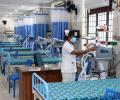
The health system is trying to ensure that it isn't caught by surprise -- the way it was last time. So, hectic preparations are on.

Audi's strategy seems to point to pushing technology to directly connect with consumers using digital platforms and marketing to synchromesh into one seamless experience, says Pavan Lall.

Since jobs will remain scarce for the foreseeable future, an unemployment allowance should be the next big social-security initiative, suggests T N Ninan.

The NINL management can see this as their moment of giving back to the nation and humanity. Its plant has an oxygen unit that can produce 418 tonnes of oxygen every day. 418 tonnes is about 58% of Delhi's daily demand for oxygen, notes Sudhir Bisht.

As the economic crisis in Sri Lanka - the world's largest exporter of orthodox tea - continues to rage across the island nation, tea producers in India look to cash in on the opportunity to seize the market. The country's largest tea growing company, McLeod Russel India, expects orders to come in from July. "A huge opportunity is coming up for everyone in India. "McLeod Russel is well placed because we have the capacity for orthodox tea," said Azam Monem, director, McLeod Russel. About 10 per cent of McLeod's production is orthodox tea.

According to the sources, there are limited prospects of J&J exporting its vaccine from the US to other countries in the near future and the "entire production" at the BE facilities in India, beginning July/August, will be handed over to the pharma giant under a contract between the companies.

Stocks of Indian companies with exposure to Europe fell on Tuesday amid concerns about the impact on their sales in case the Russia-Ukraine crisis worsens and the US and its allies impose economic sanctions on Russia. While top conglomerates, including Reliance Industries, the Tata group, and Aditya Birla Group, said they did not have any significant exposure to Russia, executives of some of the oil and gas, pharmaceutical, and tea companies said they were monitoring the situation closely as they earned substantial income from the region. Russian President Vladimir Putin on Monday ordered troops into two breakaway regions of eastern Ukraine after announcing that Russia would recognise their independence.

The major milk-producing districts of Kolhapur, Sangli, Satara, Ahmednagar and Nashik supply bulk of the stock to Mumbai and Pune.

In a bull-case scenario it sees the Sensex at 61,000 levels, while it's bear case scenario pegs the Sensex at 41,000 levels by December 2021.

The query was put to the Centre by a bench of Justices Vipin Sanghi and Rekha Palli which during the hearing said the central government has to either show some justification for this or "make amends" now that the situation has been brought to its attention.

Describing the surge of COVID-19 infections and deaths in India as 'nothing short of heartbreaking', Vice President Kamala Harris said on Friday that India's welfare is critically important to the US.

Indian citizens in Eastern China Region may apply at the Embassy of India, Beijing for availing urgent consular services, the Consulate said in a notice issued on Tuesday.

Speaking after interacting with gram panchayats and pani samitis/village water and sanitation committees (VWSC) on the Jal Jeevan Mission, Modi said the mission is not just about bringing water to people but it is also a decentralisation movement that is village and women-driven.
 © 2026 Rediff.com - Advertise with us - Disclaimer - Privacy Policy - Sitemap - Feedback - About us - Terms of use - Grievances